How Clownfish Reproduce: Sex Change, Egg Care and Anemone Romance
Behind the cute orange face hides one of the strangest reproductive lives on the reef: protandrous hermaphroditism, devoted dads and a strict matriarchy.
The clownfish — anemonefish to scientists — is arguably the most photographed reef fish on Earth. But the real story is far stranger than any cartoon: every adult male is born ready to become female, and every nest is fiercely guarded by the father.
A strict matriarchy in every anemone
Each host anemone shelters a small clownfish society: one dominant female (the largest fish), one breeding male (the second-largest), and several smaller non-breeding males waiting in line. The hierarchy is enforced through gentle but constant aggression.
If the female dies or disappears, something extraordinary happens within days: the breeding male changes sex and becomes the new female. The largest non-breeder then matures into the new breeding male. This is called protandrous hermaphroditism — male first, then female.
Courtship and spawning
Spawning typically occurs around the full moon, when tides are strongest. The male prepares a nest by cleaning a flat piece of rock or dead coral immediately beside the anemone — biting away algae for hours.
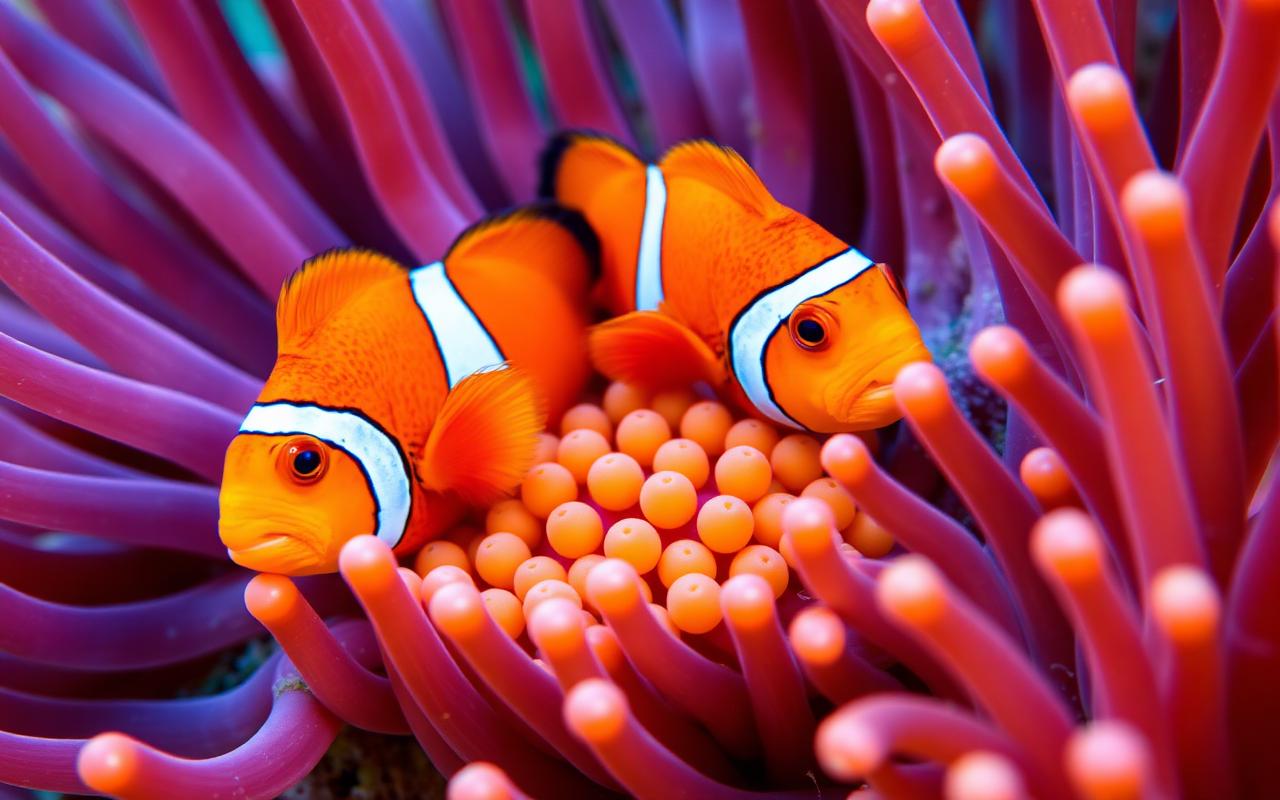
When ready, the female deposits 100 to over 1,000 amber-orange eggs in a tight oval patch. The male follows, fertilising them externally. The whole event takes about 1–2 hours and may repeat every 12–18 days throughout the warm season.
Devoted fatherhood
From the moment fertilisation ends, the male takes over almost all parental duty. For 6–10 days he fans the eggs constantly with his pectoral fins to oxygenate them, mouths them to clean off debris, and aggressively chases away any intruder — including divers.
Eggs change colour as they mature: bright orange (day 1), darkening to brown (day 4), then silvery as the embryos’ eyes become visible (day 7+). Hatching always happens just after sunset, usually within an hour of full darkness, to give the larvae the best chance of escaping daylight predators.
From plankton to anemone
Newly hatched larvae are translucent and just a few millimetres long. They drift in the open ocean as plankton for 8–12 days, then — guided by smell, sound and reef cues — actively seek out an anemone to settle in. Mortality is extreme: of 1,000 eggs, perhaps one or two will reach adulthood.
For divers, this is why every clownfish-and-anemone scene is a small miracle. Watch quietly from a respectful distance, never block the male’s patrol path, and you may witness one of the reef’s most tender behaviours.
Ready to dive Marine Life?
Let our experts design a custom itinerary tailored to your level and bucket list.
Create my dive tripFrequently asked questions
How many clownfish species are there?+
About 30 species, all in the genus Amphiprion (plus the closely related Premnas). Asia hosts the highest diversity, especially in the Coral Triangle.
Do clownfish always pair with the same anemone species?+
No — different clownfish species have different host preferences. Some are specialists (one anemone only), others are generalists.
Why don’t clownfish get stung by anemones?+
A specialised mucus on their skin chemically mimics the anemone’s own surface, switching off the stinging response.